
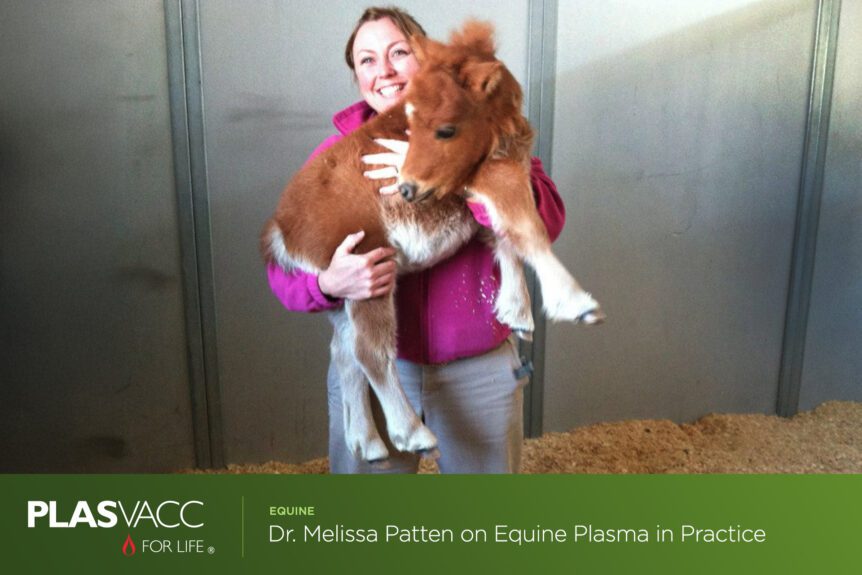
From her early days showing horses on California’s Central Coast to running a thriving equine reproduction practice, Dr. Melissa Patten has built her career around helping horses thrive. As owner of River Grove Veterinary Services in Paso Robles, California, she manages hundreds of mare breedings each year, with plasma playing a key role in ensuring foals receive the strong immune start they need.
While Dr. Patten’s practice is based in the United States, her approach and outcomes are immediately relevant to equine veterinarians in Australia. The challenges of foaling, disease exposure, and passive transfer failure are consistent across hemispheres, and Equiplas® plasma meets the same rigorous standards across international markets, including APVMA & NZFSA registration.
We spoke with Dr. Patten to hear her insights on plasma use and why she considers it one of the most impactful tools in equine medicine today.
What is your veterinary practice like? How many patients do you treat in a given year?
My practice is 90% reproduction, and we breed 200–300 mares per year.
How have you incorporated plasma into your practice? Is it part of a standard of care, or is it used only on a case-by-case basis?
We use plasma as a preventative in foals for farms with endemic disease, as well as high-value foals that owners want to have the best start possible. We also use plasma in horses with systemic diseases that are affecting clotting.
Why should plasma be an item in every vet’s toolkit?
Plasma saves lives and protects against disease. We have consistently seen foals thrive that receive plasma.
What Equiplas® products do you use personally in your practice?
Equiplas R, Equiplas, Equiplas REA, and custom plasma.
In what particular conditions or cases have you consistently seen strong outcomes from plasma products?
Rhodococcus equi, Rotavirus, Clostridium, and clotting disorders.
What would you say, in your opinion, the value proposition is for using the Equiplas® line of products?
Using Equiplas helps protect against disease and gives foals the chance to grow without fighting disease.
Do you have any anecdotes or specific cases where Equiplas® has played a unique or important role?
I had a client whose horse got into squirrel bait (poison), ingested a large quantity of it and was not doing well at all. I administered plasma, which helped save his life.
How would you describe the importance of having a registered, commercially available source of plasma in your practice?
I love having a product that I am confident in that won’t give my patients reactions and that I know has what they say is in the bag.
Do you see equine plasma treatments as one of the more impactful treatments in your field?
Yes, it is very impactful in my practice, as its administration directly saves lives.
Closing Thoughts
Dr. Melissa Patten’s experience illustrates a truth recognised by equine professionals everywhere: the value of plasma is both immediate and enduring. Whether treating a foal at risk of infection or managing a systemic illness, plasma gives veterinarians a reliable way to support the body’s immune system at its most vulnerable stage.
At Plasvacc Australia, Equiplas® is produced to the same rigorous standards as the plasma products Dr. Patten trusts in her U.S. practice: single-source, cell-free, and 100% traceable.
To learn more about how Equiplas® can support your equine patients, visit our Equine Plasma Products page, explore our Plasma Transfusion Guide, or read more about Failure of Passive Transfer in Foals.

